Big, tiny and deep: Meet all the ocean ambassadors
This MPA Day, you can discover your own Tiny 5 and help science at the same time. For those, who enjoy diving, snorkelling or just exploring rocky shores with a camera, MPA Day 2022 and iNaturalist are hosting a BIOBLITZ on the weekend July 30 and 31.
While many visitors to South Africa are familiar with ‘The Big 5’ of the African bush, few are aware of the many important undersea ambassadors that inhabit the coastal waters.
In celebration of MPA Day on Monday, 1 August, it’s time to meet these interesting and ecologically significant residents of South Africa’s Marine Protected Areas (MPAs).
“Marine Protected Areas are our ‘game reserves of the sea’, and just like our game reserves, there are many interesting and exciting animals to look out for,” explained Dr Judy Mann, executive of strategic projects at the Two Oceans Aquarium Foundation.
This MPA Day, she stated that they want to introduce people to the Big 5, the Tiny 5, and the Deep 5- 15 incredibly unique and vitally important ocean ambassadors living along the coast.
Meet the MPA Big 5
Just like their game reserve counterparts, the Big 5 are some of the most captivating animals to view in real life, and it’s certainly an experience to remember. Many of the Big 5 can be found moving through several of South Africa’s MPAs.
African penguins
These iconic birds are loved for their comical waddle and the bonds that they form with a partner for life. They are also sentinels for the environment- and today African penguins are telling us that something is very wrong in our oceans. African penguin numbers are decreasing at a rapid rate because their food sources are running out. Our MPAs can protect penguins, but they really need more fish in the sea to survive.
Sunfish
Ocean sunfish are graceful, charismatic fish. Their strange shape and enormous size makes them perfect ocean ambassadors, igniting interest and intrigue. They are wide ranging and visit many of our MPAs, especially those around the Western Cape.
Leatherback turtles
These enormous ocean wanderers nest on the beaches of the iSimangaliso MPA. Lugging their huge bodies up the beach, the females carefully dig a nest in which they lay their precious eggs. After two to three months the tiny turtle hatchlings emerge from the nests, and scurry down the beach to start their slow and dangerous journey to adulthood.

Humpback whales
These whales are unmistakable with their enormous flippers, deep groves along their throats and tiny dorsal fins. They delight people with their spectacular leaps as they cruise the southern African coast between May and November, each year. Humpbacks head up to warm, tropical waters to calve in winter before heading back down to feed in the plankton-rich Southern Ocean during summer.

ALSO READ: Everyone is invited to celebrate Aliwal Shoal on MPA Day
Whale sharks
Whale sharks are the largest fish in the ocean, reaching lengths of over 14m. These enormous fish eat plankton and occur in most tropical and sub-tropical waters. They can cover vast distances across ocean basins and will sometimes undertake dives to great depths. These gentle giants are threatened with many being killed due to ship strikes in busy shipping lanes.
Meet the MPA Tiny 5
On the other side of the scale are the Tiny 5- but don’t be fooled by their size! These little ocean creatures are just as important as all the other ocean ambassadors. And the good news is that many of them are easy to find in coastal MPAs.
Knysna seahorse
These unusual fish have a strange reproductive style- the males have a pouch in which the female lays her eggs and, once hatched, the male ‘gives birth’ to the young. The Knysna seahorse is now very rare, residing in only three estuaries in the Western Cape.

Anemones
Anemones are predators that look like pretty flowers and are often found in intertidal rock pools. The tentacles, armed with stinging cells, sting their prey, which is then moved to the mouth and swallowed. Anemones are related to corals.

Bluebottle
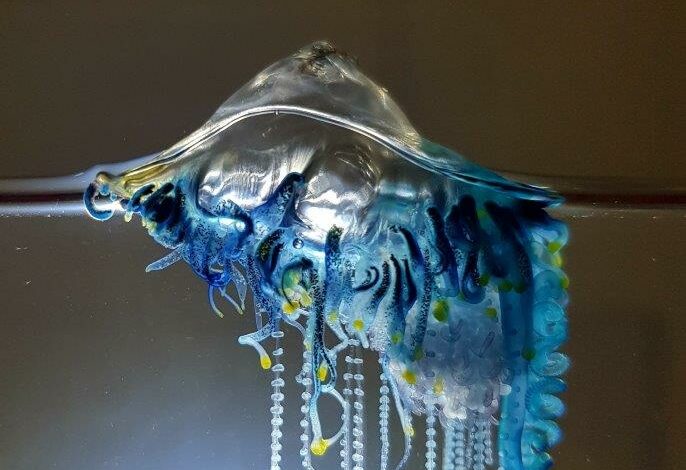
Each bluebottle is in fact a colony of highly specialised animals. One individual forms the float, others are for feeding, and others for reproduction. No one individual can live without the rest of the colony. The stinging cells on the tentacles can inflict a painful sting.
Sea urchins
Sea urchins have a body enclosed in an external, round shell made of calcium carbonate. For defence, sea urchins have many sharp spines covering their shells. Sea urchins graze on algae covering the rocks by using chisel-like mouth parts.
Cleaner shrimp
These busy little shrimps bustle around removing parasites and infected bacterial growths from bigger fish. Their bright colours signal to fish that they are not to be eaten- they are there to help.

Meet the MPA Deep 5
Going deeper into South Africa’s Marine Protected Areas, there is a whole world to be discovered! Here’s a look at some of the interesting residents found in our deep oceans.
Coelecanth
Often called a living fossil, coelacanths were thought to be extinct until one was discovered in 1938. In recent years scientists using special deep diving submersibles have found many individuals living in the deep canyons in the iSimangaliso MPA.
Volcano sponge (Pheronema) First seen in 2002 by scientists in a submersible, Pheronema sponges live in canyons at depths of 130-160m off the east coast of South Africa. Providing shelter for fishes such as pineapple fish, bigeyes and swallowtails, these enormous sponges filter substantial volumes of water.
Kingklip
Although considered a delicacy on the plate, the kingklip is not an attractive fish. It is mottled pinkish-brown in colour and has a long body that tapers to a point. They live far offshore in depths of 50 to 100m and are caught by both bottom trawlers and demersal longline fishing vessels.
ORI spider crab This unusual crab was named after the Oceanographic Research Institute in Durban to honour the Institute’s 70-year history of research. Spider crabs have a relatively small body and 10 long legs. This species lives in the deep waters off the east African coast.
John Dory
With a big black dot on either side of an oval-shaped body, this is a strange looking fish. They live at depths of 50 to 400m where they like to feed on small fish, crustaceans and squid. Bottom trawl nets often catch these popular eating fish.
iNaturalist BIOBLITZ weekend:
The study of the natural world and the scientific research that informs conservation policy is not exclusive to experts working behind closed doors- the public can greatly assist by becoming citizen scientists and sharing images and information that could have a direct impact on important studies.
iNaturalist is a platform where anybody can share photos of organisms they observe- from birds and bugs, to plants and parasites. And you do not need to be able to identify the organisms because the community of naturalists will work together to do that!
Citizen science platforms like iNaturalist are an important for learning where species are found, their abundance, and even discovering new species! The launch of a South African MPAs project on iNaturalist creates a collaboration space where divers, beachcombers, anglers, and even families visiting rock pools can be involved in studying the country’s unique MPAs.
This is a space for both citizen science and the appreciation of the thousands of incredible species found here.
This MPA Day, you can discover your own Tiny 5 and help science at the same time. For those, who enjoy diving, snorkelling or just exploring rocky shores with a camera, MPA Day 2022 and iNaturalist are hosting a BIOBLITZ on the weekend July 30 and 31.
Check out the link- https://www.inaturalist.org/projects/south-african-marine-protected-areas-mpas- to find out more about South Africa’s MPAs how your photos can contribute towards scientific research that protects them.