1946 Passive Resistance remembered
The square, which is now Nichol Square Parkade, was the main place for political meetings in the 1940s and 1950s.
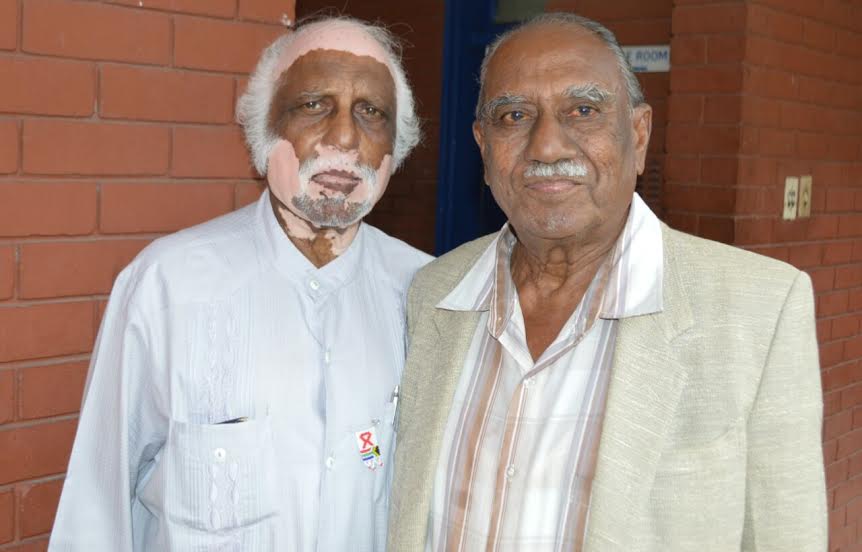
Two veterans of the 1946 Passive Resistance gathered at Red Square in Durban on Monday to recall the historic events of 70 years earlier. The square, which is now Nichol Square Parkade, was the main place for political meetings in the 1940s and 1950s.
Kay Moonsamy, who turns 90 on July 5, spent his 20th birthday in prison for his part in defying the law. The protests were against the government’s attempts to segregate land for Indian people.
Hundreds of families lost their homes as they were forcibly removed. Moonsamy was joined by Swaminathan Gounden, 88, who followed Natal Indian Congress (NIC) president Dr Monty Naicker’s instructions to recruit volunteers to go to prison to protest the law.
The resisters illegally occupied a small patch of land between Gale Street and Umbilo Roads in Durban. They set up tents there. Following the Gandhian tradition, they willingly offered themselves for arrest. White hooligans viciously attacked even the women protesters while the police watched idly.
Moonsamy said, “I recall that the Durban Central jail was overflowing with the scores of passive resisters coming in daily. The jail was just behind the old Railway Station where the ICC now stands. “Remember I only stayed at the Durban Prison for about ten or twelve days. All of those who were sentenced to more than four months were shunted to Ixopo Prison. I remember RA Pillay was with me. He was an old stalwart in the movement who went to prison more than once. We marched from Durban Central Jail to the railway station. We were all handcuffed marching to the station and they put us into the third class. By the time we arrived in Ixopo was about seven in the evening. It was already dark. They gave us clothing. In Durban Central we were wearing shorts made out of hessian sacks. Of the 150, 18 of us were taken to Ixopo.”
Azad Seedat the son of one of the first volunteers Fatima Seedat said that his mother donated her wedding earrings to the passive resistance fund. She and her husband Dawood Seedat who would have turned 100 years this year were iconic leaders of the non-racial activism.
According to the records put together by Dr Enuga Reddy and Professor Fatima Meer, 1710 passive resisters served imprisonment. The majority were workers. Of those, 1476 were aged between 18 and 30. While the majority were men, 279 women were imprisoned.
Mrs Ellapen Naicker served seven months. Dr Monty Naicker and Mr MD Naidoo served 6 months and 7 days. Five doctors including Dr K. Goonum were imprisoned.
Gounden said, “There were 210 resisters imprisoned twice, 21 imprisoned thrice and 31 imprisoned four times. To demonstrate the unity in diversity, 48 coloureds, 16 Africans and 8 whites went to prison in solidarity.”
On 2 June 1948, the Joint Passive Resistance Council suspended the campaign pending discussions with the Nationalist Party government which won the May election on the apartheid ticket.
The racist state did the opposite and intensified the repression passing the Group Areas Act in 1950. Moonsamy continued his activism in the Congress Movement. He was active is all the major political campaigns thereafter. In 1956 he was among the 156 leaders charged alongside Nelson Mandela, Walter Sisulu and Oliver Tambo in the Treason Trial.
In 1964, he was arrested under the 90 Day Laws and detained in solitary confinement together with Gounden. Moonsamy then left the country clandestinely on 29 June 1965 to join the external mission of the ANC. President Jacob Zuma this year conferred on him the Order of Luthuli in bronze for his contribution to the struggle for South African freedom.