First Indian Special Forces Commando called to higher service
As a young naval recruit, basic military training had him walk the halls of the SAS Jalsena Training Unit, translating from Hindi to ‘Sea Warrior’. The unit was originally formed in 1975 and named the South Africa Indian Corps Training Battalion (SAICTB) and later renamed SAS Jalsena.
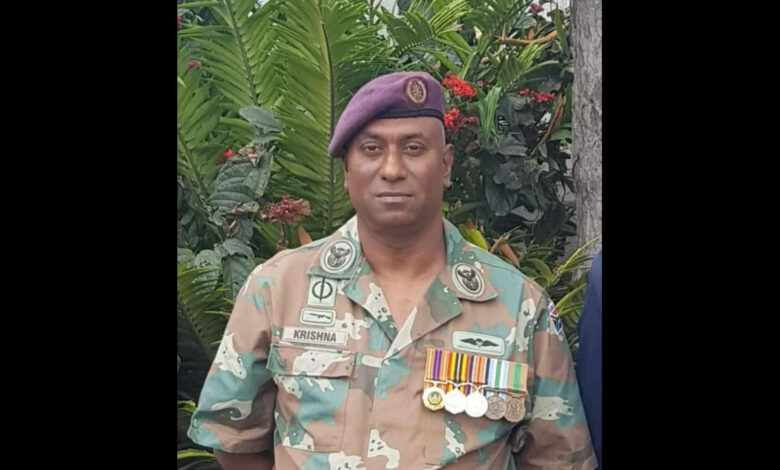
W/O Laren Krishna is the name attached to a story of an unknown Indian Recce Commando and youngster who defied all probabilities based on a marginalised system.
Dating back as far as the Anglo-Boer War with ideologies of non-combat roles for Indians in military service, Phoenix-born W/O Krishna, succeeded in becoming the first and only Indian, qualifying to become a part of one of the most elite military units in the world, the South African Special Forces also known as ‘The Recces’.
The 59-year-old father of two sadly passed away on Monday. Born into the community of Campbell’s Town in Mount Edgecombe, north of Durban, W/O Krishna was one of four siblings to Mr and Mrs Krishna, whose origins are of Indian descendants from the 1860 migrant indentured labourers.
Growing up in the late 1970s and early 1980s in the characteristic Indian community, the vision to enlist into the military was not one generally promoted within the community or reaching the prestigious accolade of becoming part of an elite military unit was far-fetched.
As a youngster, Krishna attended government schools and played informal sports along the cane fields of KwaZulu-Natal.
The young visionary saw himself within the military and pursued his aspirations in January 1984 as part of the two-year voluntary national serviceman programme for Indians in the South African Navy.
As a young naval recruit, basic military training had him walk the halls of the SAS Jalsena Training Unit, translating from Hindi to ‘Sea Warrior’. The unit was originally formed in 1975 and named the South Africa Indian Corps Training Battalion (SAICTB) and later renamed SAS Jalsena.
To participate in Special Forces Selection, an applicant needed to meet the very high psychological and physical requirements of the course.
The Special Forces Cycle was a gruelling eight months and later extended to the current two years cycle, which saw more than 90 percent of the students drop off with only a few earning the prestigious title of ‘Recce Operator’.
The programme includes qualifying as a paratrooper, training in the field of demolition, basic medical training, urban warfare and bush warfare training.
Krishna joined 1 Recce Regiment in December 1985 and on April 16, 1987, qualified to be the first and to date, the only South African Special Forces Operator of Indian descent.
The South African Special Forces or Recces as they are commonly known are rated among the best in the world, a special breed of men who are legendary and mentioned in many books across the world.
On completion of the Special Forces course, Krishna joined 1 Reconnaissance Regiment previously situated on the Bluff, Durban, and in qualifying as a Special Forces Operator defied the odds in proving the stereotype wrong with regards to the role of Indians in combat.
ALSO READ: First commemorative service in memory of Indian soldiers
While serving with the unit, speaking out against the injustices based on race under apartheid was dangerous, especially if one was part of an elite military unit.
Under the difficult circumstances, W/O Krishna persevered to be a professional soldier upholding his duty to the unit and organisation with unfaltering loyalty.
Standing up and raising issues of injustice created hostility from colleagues which led to his phone being tapped and another sequence of events gave him good reason to believe that his personal safety and the well-being of his family was under threat.
At the age of 20, during the pinnacle of the Angolan bush war conflict, W/O Krishna became operationally active in Angola with his involvement in the notable Operation Modular.
He also participated in other cross-border military operations during the South African Border War and in the build-up to democratic change, transferred to the broader South African Army where he was involved internally and in the Black townships during the turbulent times before and after the first democratic elections in 1994.
W/O Krishna served his country with pride and dedication and was still a serving member of the South African National Defence Force, a proud soldier and family man.
In his later years, he dedicated his time towards developing community uplift programmes, one in particular, an anti-bullying programme aimed at school children and designed to change the lives of young victims of society.
The military memoirs of W/O Krishna are currently being encapsulated in the form of a biography soon to be published. The novel forms part of the greater project to document and preserve the military contribution of South African Indians.
W/O Krishna is among the privileged few to have had the honour to serve operationally within an elite military unit and to have earned the title of Recce Commando.
The South African Indian Legion (SAIL) have passed their deepest sympathies to friends and family of Krishna on his passing, yet hope to encapsulate his heroics through books and publications.